
Group Orders
All you need to know, in one spot!☝🏼
🪴Are you interested in changing lives?
Great! We have the teaching and homework covered, just gather a group and open up meaningful discussions using lessons you have experienced in your own life.
Whether you order materials for everyone or students purchase individually, getting started is simple.
-
Don’t worry if you are a little intimidated to teach a personal finance class, the pre-recorded lectures provide all of the actual financial teaching required. We look to you to enhance the class with stories of your own financial experiences. Real life stories of financial truths in action cement the lessons in the minds of the student.
-
BEFORE PERSONAL FINANCE
Before Personal Finance includes 10 lessons designed for ages 8–13. Each lesson takes up to two hours to complete, but it’s flexible — the four parts (teaching, activity, budget preparation, and quiz) can easily be split into class and homework sessions to fit your schedule. There are no videos — just hands-on workbook lessons that make learning about money fun, engaging, and easy to understand.
BEYOND PERSONAL FINANCE
Beyond Personal Finance is designed to be taught in a one-hour class setting with a structure that looks something like this:
Play the icebreaker Kahoot! as people arrive and get settled. (10 mins)
Watch the instructional video. (20-30 mins)
Discuss the instructional video and homework assignment. (10 mins)
Do the budget activities (plot twists, baby game, etc) and discuss how students feel about their budget given the choices presented in the lesson. (10 mins)
If you have more time, consider working through the budget homework in class.
If you like the interactive feel of working through the budgets together but only have an hour, consider having your students watch the instructional video at home prior to class.
-
Yes! When you purchase the Group Experience, you receive 425 days of access—that’s an extra 60 days beyond the standard membership—giving you plenty of time to plan, prepare, and get comfortable with the material before your group begins. This extended access is just one of the many perks of the Group Experience.
-
-
Yes! For the tween product, simply use this link to make additional workbook purchase. For the teen program use this link and the coupon code given to you upon purchase of the group material to provide to anyone who joins your group.
If you have made a bulk purchase of either of our products and would like to purchase another set of student materials, please send us an email so that we may keep your pricing consistent.
-
While the life lessons in this class are appropriate for all teens, there are some lessons that require computations that might be beyond a younger student's capability. Take our assessment to determine if a student is ready for this class.
-
Not at all! Both Before Personal Finance and Beyond Personal Finance are designed to be self-explanatory, but we know a little support can make a big difference. Our team is always available by email and strives to respond to all messages within 24 hours on weekdays, so you’re never on your own.
Also, when you purchase the Group Experience for Beyond Personal Finance, you’ll have an opportunity to attend on of our live Train the Teacher session, held monthly via Zoom, where we walk through best practices and answer common questions. You’ll also gain access to a private online community of group leaders—a dedicated portal filled with ongoing questions, comments, and ideas from other leaders, organized by topic and moderated by our team so you can easily find and interact with what’s most relevant to you. This exclusive community is one of the perks of the Group Experience.
-
Absolutely! You can find the full Scope and Sequence for Beyond Personal Finance at the end of this page 👇🏼. It outlines every lesson, topic, and skill your student will cover over the 20-lesson semester—so you’ll know exactly how the course progresses and how each concept builds on the last.
See our Group Products Below !
👨🏼🦰👩🏽🦱👨🏻🦱👩🏻👨🏽🦰
See our Group Products Below ! 👨🏼🦰👩🏽🦱👨🏻🦱👩🏻👨🏽🦰

👨🏼🦰👩🏽🦱👨🏻🦱👩🏻👨🏽🦰 Money Lessons Are Better Together
Beyond Personal Finance is a one-semester life simulation that turns money lessons into real decisions. Students don’t just learn about budgeting—they live it by choosing a career, renting an apartment, buying a car, getting married, investing, and even planning for retirement.
In a group setting, this experience becomes even more powerful. As each student makes different choices and follows their own financial path, conversations spark, comparisons unfold, and real-world lessons sink in deeper. Teens learn not only from their own decisions—but from each other. Want to see exactly what they’ll learn along the way? View the full Scope and Sequence here.
📦 What You Get With Your Group Purchase
425-Day Online Membership: Plenty of time to prepare before your school year begins and complete the program with your group.
Group Portal Access: Includes pre-recorded video teaching, interactive classroom games for each lesson, and electronic + hard copy assignments and tests.
Full-Color Teacher Workbook: Mirrors the Student Workbook and includes detailed answer keys to make teaching and grading straightforward.
Online Teacher Resources: Brief coaching videos for each lesson, answer keys, lesson plans, grading sheets, and more—all in one place.
Group Leaders Community: Join a nationwide network of leaders to share ideas, get advice, and learn from others using Beyond Personal Finance.
Welcome Call with Our Team: A one-hour phone or video call to help you seamlessly incorporate the program into your group. 🔗 [Click HERE to RSVP]
Alumni Pricing for Renewals: Special pricing to make renewing your subscription for future groups easy and affordable.
🛒 How to Purchase
You can either:
Purchase for the group by selecting the number of Student Workbooks in the dropdown menu (bulk purchase rates apply), or
Purchase Teacher Materials only, and we’ll provide you with a unique code for your students to use when purchasing directly from us that will give them 20% off their workbook.

Learning is better together! 👩🏻👨🏽🦰👨🏻🦱👩🏽🦱👨🏼🦰
When students take the course alongside siblings or peers, they gain fresh insights by seeing the different choices and paths others take. Each decision leads to a unique outcome, sparking meaningful conversations and making the experience more engaging and memorable.
This product is for students joining an existing member or group. It includes one Student Workbook and one year of access to the online content — all for just $55 (a discount of $105 from the first student/parent package).
Please note that Teacher Portal access is not included. To purchase the full curriculum with Teacher access, see the Beyond Personal Finance Teen (Ages 13+) Curriculum option below. 👇🏼

The Personal Finance Course Teens Actually Love
What if your teen could practice adulthood before stepping into it? Beyond Personal Finance is a one-semester life simulation that turns money lessons into real decisions. Teens don’t just learn about budgeting—they live it, choosing a career, renting an apartment, buying a car, getting married, investing, and even planning for retirement. In just 20 engaging, self-paced lessons (under two hours each), they’ll connect personal choices to real financial outcomes and discover whether their dream lifestyle actually fits their paycheck. This will be the class your student talks about for the rest of their lives.
📦 What You Get With Your Purchase
365-Day Online Membership: Start anytime. Extend up to 60 days if life gets busy.
Student Portal Access: Engaging, self-paced video teaching—professional, relatable, and built to hold your teen’s attention. 🔗Take a look at a snippet from Lesson 3 HERE
Full-Color Student Workbook: Interactive pages that transform the video teaching into personal choices. 🔗Take a look at some key pages from Lesson 3 HERE
Assignments & Tests: Available both electronically and as printable PDFs—flexibility for your student’s learning style.
Teacher Portal Resources*: Lesson plans, extension ideas, and brief coaching videos in your own portal to guide you every step.
*The optional Teacher Workbook is designed to support the teaching process. It mirrors the Student Workbook and includes detailed answers for each exercise and activity, making it easier for parents to follow along and support their teen’s learning. While not required, many parents find it a valuable tool for staying engaged with their student’s progress. You can learn more by selecting the Beyond Personal Finance Teen Curriculum Teacher Workbook below👇🏼

👨🏼🦰👩🏽🦱👨🏻🦱👩🏻👨🏽🦰 Money Lessons Are Better Together
Before Personal Finance introduces late elementary students to the foundations of money—spending, saving, investing, and borrowing—through imaginative, hands-on lessons. Across 10 engaging activities, students guide their avatar, Future You, through key financial choices from ages 13 to 22. Along the way, they budget for snacks, clothes, travel, and even a car, while spinning a wheel to uncover unexpected financial twists that make each lesson unique and memorable.
Learning in a group setting adds a whole new layer of fun and insight. As each student makes different decisions and faces different outcomes, conversations come alive. Students compare paths, learn from each other’s choices, and see firsthand how financial decisions shape their future in different ways.
📦 What You Get With Your Group Purchase
Full-Color 150-Page Student Workbooks (Bulk pricing at 7+ workbooks)
Each student receives their own workbook—everything they need is inside. (No video teaching required.)Free Teacher Materials
Includes a short “how to” video, answer keys, activity resources, and more—all provided at no extra cost through our class website (URL included inside the workbook). Access does not expire.
Beyond Personal Finance Teen (Ages 13+) Curriculum Scope & Sequence
🗒️
Beyond Personal Finance Teen (Ages 13+) Curriculum Scope & Sequence 🗒️
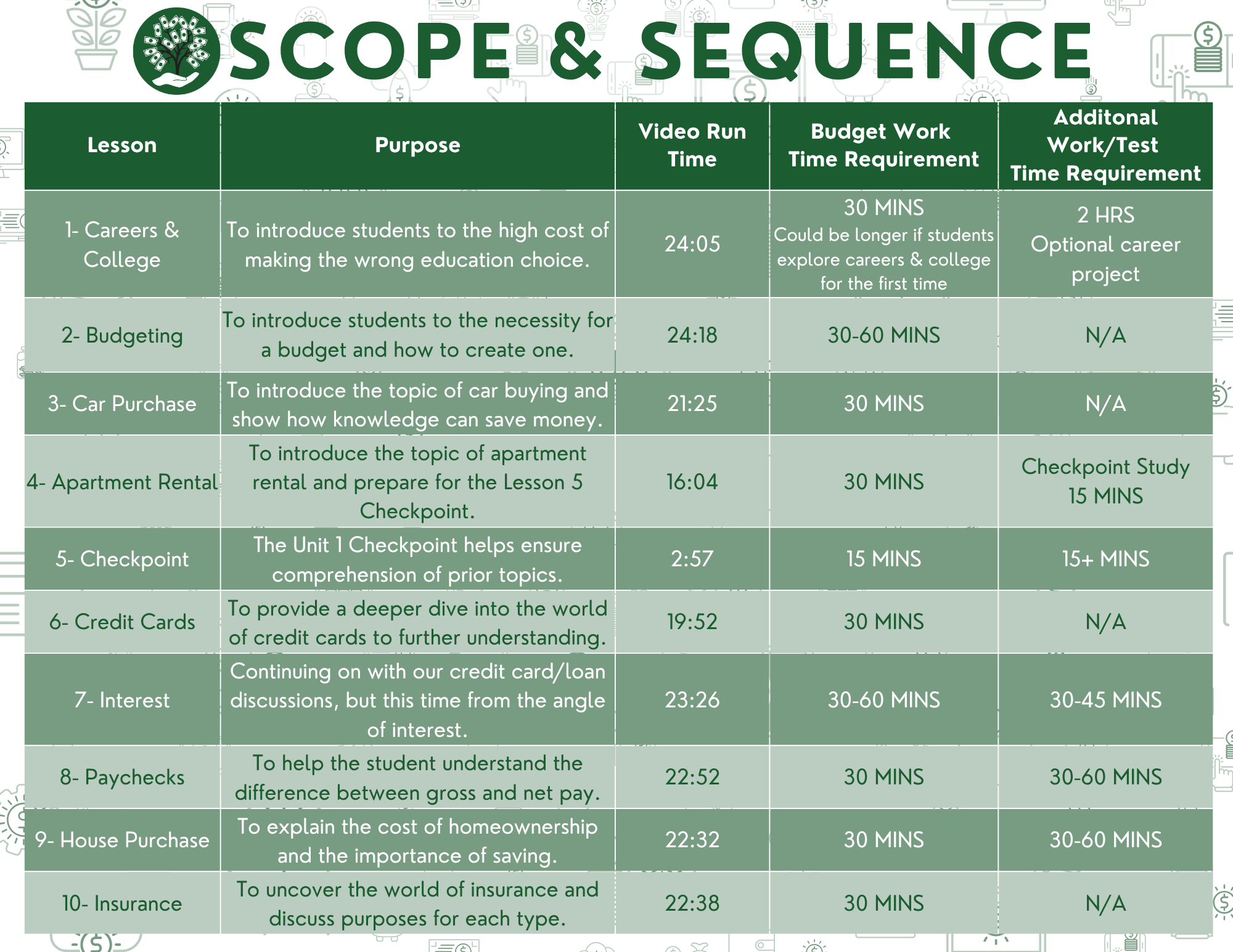

Want to teach a teen group, but don’t meet 20 times?
No Problem! Find examples of alternative class meeting options 👉🏼
-
Beyond Personal Finance includes 20 lessons, each representing a year in your student’s simulated life with new decisions, expenses, and financial outcomes every step of the way. Because each budget builds on the one before it, it’s essential not to skip any lessons. Skipping a lesson means skipping a year of earnings, spending, and saving! Your students will miss the chance to build their financial nest egg. 💰
The curriculum is designed for a one-hour class session, but can easily flex to fit different schedules. Here’s a typical class flow:
Suggested One-Hour Structure
Play the icebreaker Kahoot! as students arrive (10 min)
Watch the instructional video (20–30 min)
Discuss the video takeaways and homework (10 min)
Complete the budget activities (Plot Twists, Baby Game, etc.) and discuss how those choices affect their budgets (10 min)
If your class time is longer, consider working through the budget homework together in class.
If your class time is shorter or you meet less than 20 times, have students watch the instructional video at home before class so your time together can focus on discussion and the interactive budgeting activities.
The most important goal is consistency. As long as you cover all 20 lessons in order, your students will experience the full impact of “living” their financial future one year at a time.
-
1. Lesson 1 Complete the lesson in class.
2. Lesson 2 Complete the lesson in class.
3. Lesson 3 Complete the lesson in class.
4. Lesson 4 Complete Lesson 4 in class. Assign Lesson 5 for completion at home.
5. Lesson 6 Complete the lesson in class.
6. Lesson 7 Complete the lesson in class.
7. Lesson 8 Complete the lesson in class.
8. Lesson 9 Complete the lesson in class.
9. Lesson 10 Complete Lesson 10 in class. Assign Lessons 11 & 12 for completion at home.
10. Lesson 13 Complete the lesson in class.
11. Lesson 14 Complete the lesson in class.
12. Lesson 15 Complete the lesson in class.
13. Lesson 16 Complete the lesson in class.
14. Lesson 17 Complete the lesson in class.
15. Lesson 18 Complete Lesson 18 in class. Assign Lesson 19 for completion at home.
16. Lesson 20 Complete the lesson in class.
-
1. Lesson 1 (part 1) Introduce the format, begin teaching Lesson 1. Ask students to do the research on colleges at home with their parents to determine how much of the educational costs the student can expect to pay him/herself.
2. Lesson 1 (part 2) Continue with the discussion on which college (if any) they chose and why. Then you can shift gears and have them do the interest assessment (via computer) in class and choose their career. Introduce the Career Research Project and give them a deadline for a few weeks, presentations can be scheduled as time allows.
3. Lesson 2 This material can be done in one lesson. Open the discussion on budgeting and have the students complete their budget using the choices and forms from the portal (electronic or paper).
4. Lesson 3 Review the budgets and talk about what they learned from doing the first one. Have them share the choices they made and how that ties to their values (why they spent money in one area and not another). Then begin the lesson on purchasing a car, this should go fast and allow them time to choose a car and complete the budget as well.
5. Lesson 4 Review the budgets and talk about what they learned and the pros and cons of the choice they made. Open the discussion on apartments and have them choose an apartment in class (from the book or online research) and build their budget using the changes the new choice will bring.
6. Lesson 5 Review the budgets and talk about what they learned and the pros and cons of the choice they made. Do a Kahoot or other game to get ready for the test. Have them choose their pet in class. Have them take the test in class and do their budget based on the pet they chose.
7. Lesson 6 Go over raises and why some got more than others and how that correlates to the real world. Review budgets and lessons learned. Open the discussion on credit cards as well as have the students make their spouse choice and complete the budget in class.
8. Lesson 7 (part 1) Go over the budgets from Lesson 6 and review lessons learned as well as talk about their expectations for the spouse they chose. Open the discussion on interest and complete the calculations in class.
9. Lesson 7 (part 2) Continue with in class work on interest calculations as well as help the students with the process of marrying budgets.
10. Lesson 8 Open the discussion on paycheck and complete the calculations in class. Talk through what happens when a mistake is made and how it is on them to look. Students will have a baby in this lesson and that will turn their budgets upside down. Lots of fun here!
11. Lesson 9 (part 1) Talk about the impact babies had to the budget and what has been learned. Tie this into how their parents feel about paying all that money for them. Introduce the concept of buying a house.
12. Lesson 9 (part 2) Have them choose a house in class (from the book or online research) and build their budget using the changes the new choice will bring.
13. Lesson 10 Review budgets now to see how tight people are living with a child and a house. Talk about how true this is for adults. Open the discussion on insurance. They will complete their budget work and choose their furniture in this lesson also.
14. Lesson 11 This is a test review, have some fun with the vocabulary terms with Kahoot or something similar. Have the students calculate their insurance event using their newfound knowledge and complete the budget given the cost of that event.
15. Lesson 12 The test will likely take most of the time, but then you can discuss the effects on their budget now that one spouse has left the workforce. Have a discussion on the values of that decision and the pros and cons.
16. Lesson 13 This will only be one class and it will cover the importance of giving and have them quantify what they have given so far and research who they would give that money to in real life.
17. Lesson 14 (part 1) This is everyone’s favorite lesson as it deals with investing. There is much to be said on this topic beyond what I have covered so you should have some time to fill in with other resources from the portal or your own information.
18. Lesson 14 (part 2) Go over the investment choices and help them determine which choice they will make and create a budget given that choice.
19. Lesson 15 Review budgets from last lesson. Introduce the topic of business as well as work on their budget using the new school choice they make.
20. Lesson 16 Work through the material on reconciliations. Go through the layoff exercise and help the students complete their budgets based on the results. Lots of fun to be had here!
21. Lesson 17 (part 1) This is the income tax lesson that is always hard for some students. Take it slow and don’t worry if some don’t get it, they have plenty of time for their brains to develop before they really need to know this stuff.
22. Lesson 17 (part 2) Finish up taxes if needed and have them choose and budget for a new minivan.
23. Lesson 18 This is a review class as well as a time to discuss the emotional and financial impact of divorce. This is a sensitive topic, but like the other topics I feel it is more impactful for them to see what happens to their own budget rather than just saying “don’t do it”. No student actually gets divorced, but it helps them understand the impact when they do the calculations themselves.
24. Lesson 19 This is a test that will likely take the whole class, but the choice is so quick and easy you can do both in one class period.
25. Lesson 20 (part 1) Talk through raises and budgets to see where everyone stands at this point. Open the discussion to the topic of retirement and why it matters earlier than they think.
26. Lesson 20 (part 2) Final budget to see where everyone landed. This class is a lot of fun as they answer the “did you make it?” question.
-
1. Lesson 1 (part 1) Introduce the format, begin teaching Lesson 1. Ask students to do the research on colleges at home with their parents to determine how much of the educational costs the student can expect to pay him/herself.
2. Lesson 1 (part 2) Continue with the discussion on which college (if any) they chose and why. Then you can shift gears and have them do the interest assessment (via computer) in class and choose their career. Introduce the Career Research Project and give them a deadline for a few weeks, presentations can be scheduled as time allows.
3. Lesson 2 This material can be done in one lesson. Open the discussion on budgeting and have the students complete their budget using the choices and forms from the portal (electronic or paper).
4. Lesson 3 Review the budgets and talk about what they learned from doing the first one. Have them share the choices they made and how that ties to their values (why they spent money in one area and not another). Then begin the lesson on purchasing a car, this should go fast and allow them time to choose a car and complete the budget as well.
5. Lesson 4 Review the budgets and talk about what they learned and the pros and cons of the choice they made. Open the discussion on apartments and have them choose an apartment in class (from the book or online research) and build their budget using the changes the new choice will bring.
6. Lesson 5 Review the budgets and talk about what they learned and the pros and cons of the choice they made. Do a Kahoot or other game to get ready for the test. Have them choose their pet in class. Have them take the test in class and do their budget based on the pet they chose.
7. Lesson 6 Go over raises and why some got more than others and how that correlates to the real world. Review budgets and lessons learned. Open the discussion on credit cards as well as have the students make their spouse choice and complete the budget in class.
8. Lesson 7 (part 1) Go over the budgets from Lesson 6 and review lessons learned as well as talk about their expectations for the spouse they chose. Open the discussion on interest and complete the calculations in class.
9. Lesson 7 (part 2) Continue with in class work on interest calculations as well as help the students with the process of marrying budgets.
10. Lesson 8 (part 1) Lots to discuss here about the financial impact of getting married. Can they see now how important it is not to choose someone just based on what they can see? Open the discussion on paycheck and complete the calculations in class. Ask students to bring in their own paycheck stub to the next class, if they have one
11. Lesson 8 (part 2) Continue with in class work on calculating a paycheck. Use the real paystubs form students to talk about how this lines up with the calculations they have already done. Talk through what happens when a mistake is made and how it is on them to look. Students will have a baby in this lesson and that will turn their budgets upside down. Lots of fun here!
12. Lesson 9 (part 1) Talk about the impact babies had to the budget and what has been learned. Tie this into how their parents feel about paying all that money for them. Introduce the concept of buying a house.
13. Lesson 9 (part 2) Have them choose a house in class (from the book or online research) and build their budget using the changes the new choice will bring.
14. Lesson 10 Review budgets now to see how tight people are living with a child and a house. Talk about how true this is for adults. Open the discussion on insurance. They will complete their budget work and choose their furniture in this lesson also.
15. Lesson 11 This is a test review, have some fun with the vocabulary terms with Kahoot or something similar. Have the students calculate their insurance event using their newfound knowledge and complete the budget given the cost of that event.
16. Lesson 12 (part 1) The test will likely take the whole time, but if Lesson 11 ran long you could also finish that up in this class.
17. Lesson 12 (part 2) Have them complete the budget now that one spouse has left the workforce. Have a discussion on the values of that decision and the pros and cons. Should be a super rich discussion for them as one parent has likely taken a financial step back to be the primary educator.
18. Lesson 13 This will only be one class and it will cover the importance of giving and have them quantify what they have given so far and research who they would give that money to in real life.
19. Lesson 14 (part 1) This is everyone’s favorite lesson as it deals with investing. There is much to be said on this topic beyond what I have covered so you should have some time to fill in with other resources from the portal or your own information.
20. Lesson 14 (part 2) Go over the investment choices and help them determine which choice they will make and create a budget given that choice.
21. Lesson 15 Review budgets from last lesson. Introduce the topic of business as well as work on their budget using the new school choice they make.
22. Lesson 16 Work through the material on reconciliations. Go through the layoff exercise and help the students complete their budgets based on the results. Lots of fun to be had here!
23. Lesson 17 (part 1) This is the income tax lesson that is always hard for some students. Take it slow and don’t worry if some don’t get it, they have plenty of time for their brains to develop before they really need to know this stuff.
24. Lesson 17 (part 2) Finish up taxes if needed and have them choose and budget for a new minivan.
25. Lesson 18 This is a review class as well as a time to discuss the emotional and financial impact of divorce. This is a sensitive topic, but like the other topics I feel it is more impactful for them to see what happens to their own budget rather than just saying “don’t do it”. No student actually gets divorced, but it helps them understand the impact when they do the calculations themselves.
26. Lesson 19 This is a test that will likely take the whole class, but the choice is so quick and easy you can do both in one class period.
27. Lesson 20 (part 1) Talk through raises and budgets to see where everyone stands at this point. Open the discussion to the topic of retirement and why it matters earlier than they think.
28. Lesson 20 (part 2) Final budget to see where everyone landed. This class is a lot of fun as they answer the “did you make it?” question.